Pay Your Bill

  1. Home
  2. Services
  3. Women’s Imaging
  4. Supplemental Breast Exams

SUPPLEMENTAL BREAST EXAMS

How Breast Density Affects Cancer Detection

While screening mammography remains the gold standard for breast cancer detection, reducing mortality by nearly 40% in clinical trials, it has limitations for women with dense breast tissue. The American College of Radiology and the Society of Breast Imaging recommend annual mammograms starting at age 40 for average risk women.

However, breast density significantly impacts detection accuracy. Mammography’s sensitivity drops from 85-88% in fatty breasts to just 62-68% in extremely dense breasts due to a masking effect, which can lead to interval cancers (cancers diagnosed within a year of a normal mammogram). This is why women with dense breasts may benefit from personalized breast care that includes supplemental screening.

As an accredited Breast Imaging Center of Excellence, Inland Imaging offers multiple advanced screening options specifically designed for women with dense breasts, ensuring more comprehensive and accurate cancer detection.

Women smiling for a picture as a group together.
Doctor performing breast ultrasound on women.

WHOLE BREAST ULTRASOUND AND AUTOMATED BREAST ULTRASOUND (ABUS)

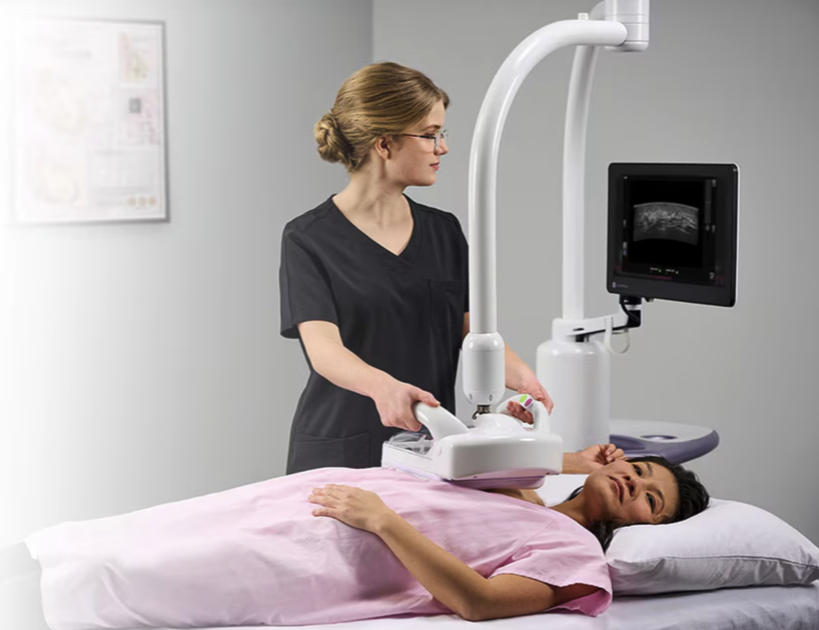
Invenia ABUS (GE) is the only ultrasound technology FDA-approved for breast cancer detection in women with dense breasts. The exam is comfortable for patients, does not require IV contrast, and does not use radiation. Research shows that supplemental ultrasound, used in addition to a yearly mammogram, can detect 3 additional cancers per 1000 women. ABUS is covered by most insurance plans. ABUS is purely a screening exam for asymptomatic patients and should not be used for diagnostic purposes.

Which patients should consider ABUS:

  • Average or intermediate-risk women with dense breasts and a normal mammogram within 1 year
  • High-risk women who cannot undergo a screening breast MRI due to physical limitations

BREAST MRI AND ABBREVIATED BREAST MRI. WHAT IS RIGHT FOR YOU?

Breast MRI is the most sensitive screening exam available for detecting cancer. Full protocol MRI is recommended for high-risk women, including those with a 20% or greater lifetime risk, BRCA mutations, personal history of breast cancer (especially before age 50), or conditions like atypia or LCIS. This radiation-free exam is typically covered by insurance for high-risk patients. For average-risk women with dense breasts, Abbreviated Breast MRI (AB-MRI) offers a shorter alternative that detects up to 16 additional cancers per 1,000 women. While AB-MRI requires IV contrast and is self-pay, it provides enhanced screening beyond standard mammography.

Women smiling in portrait with trees in the background.
Three women laughing and smiling while holding arms.

BREAST BIOPSY

If imaging reveals a breast abnormality, a biopsy may be recommended to remove a small tissue sample for pathological examination. At Inland Imaging, our specialized breast radiologists determine the most appropriate biopsy technique based on your images, including stereotactic, ultrasound-guided, or MRI-guided procedures. All biopsies are performed on an outpatient basis without general anesthesia, ensuring minimal discomfort, scarring, and no overnight stay required.

Women walking free in wheat fields with sun shining in the background.

BREAST WIRE AND WIRELESS LOCALIZATION

Localization procedures help accurately pinpoint breast abnormalities for surgical removal. A localization wire can be placed the same day as surgery, or patients may choose wireless radar technology using a tiny reflector inserted days before their scheduled procedure. During surgery, surgeons electronically access imaging to locate targeted tissue, and the excised specimen is verified through imaging to confirm complete removal of the abnormality.

Patient Testimonials

Lorem ipsum dolor sit amet, consectetur adipiscing elit.

“Lorem ipsum dolor sit amet, consectetur adipiscing elit, sed do eiusmod tempor incididunt ut labore et dolore magna aliqua. Ut enim ad minim veniam, quis nostrud exercitation ullamco laboris nisi ut aliquip ex ea commodo consequat.”

Lorem ipsum dolor sit amet, consectetur adipiscing elit.

“Lorem ipsum dolor sit amet, consectetur adipiscing elit, sed do eiusmod tempor incididunt ut labore et dolore magna aliqua. Ut enim ad minim veniam, quis nostrud exercitation ullamco laboris nisi ut aliquip ex ea commodo consequat.”

Lorem ipsum dolor sit amet, consectetur adipiscing elit.

“Lorem ipsum dolor sit amet, consectetur adipiscing elit, sed do eiusmod tempor incididunt ut labore et dolore magna aliqua. Ut enim ad minim veniam, quis nostrud exercitation ullamco laboris nisi ut aliquip ex ea commodo consequat.”

Frequently Asked Questions

Supplemental breast exams are additional screening tests beyond standard mammography, designed to improve cancer detection in women with dense breast tissue. Options include automated breast ultrasound (ABUS), full protocol breast MRI, and abbreviated breast MRI (AB-MRI).

Your breast density is determined through your mammogram results. Your radiologist will notify you if you have dense breasts, which affects approximately 40% of women. Dense breast tissue can make it harder to detect cancer on a standard mammogram.

Supplemental screening is typically performed annually in conjunction with your regular mammogram. Your radiologist will recommend the appropriate screening schedule based on your individual risk factors and breast density.

ABUS (Automated Breast Ultrasound) is FDA-approved ultrasound technology for detecting breast cancer in women with dense breasts. It’s ideal for average or intermediate-risk women with dense breasts and a normal mammogram within one year, or high-risk women who cannot undergo breast MRI.

Full protocol breast MRI is the most comprehensive screening exam, recommended for high-risk women and typically covered by insurance. Abbreviated breast MRI (AB-MRI) is a shorter version designed for average-risk women with dense breasts. While AB-MRI is self-pay, it takes less time and detects up to 16 additional cancers per 1,000 women.

High-risk women include those with a 20% or greater lifetime risk of developing breast cancer, BRCA gene mutations, personal history of breast cancer (especially before age 50), or conditions like atypia or lobular carcinoma in-situ (LCIS).

Accredited Excellence

Nationally ranked for excellence, we are the region’s only Breast Imaging Centers of Excellence recognized by the American College of Radiology. From convenient appointments to the highest levels of technology and expertise in the region, everything we do is built around you.

Scroll to Top

Home

Edit Content

Types of Imaging

About MRI

Alzheimer’s Screening

Body MRI

Breast MRI

Cardiac MRI

Head & Spine MRI

MRI DefecographyMSK

MRI

Prostate MRI

About Computed Tomography (CT)

Coronary Artery Screening CT Exam

Coronary CT Angiography
CT Lung Screening

Virtual Colonoscopy

About Nuclear Medicine

Bone Imaging

Brain Scan

Cisternogram

Gallium Scan

Gastric Emptying

Gastrointestinal

Hepatobiliary Scan

I-123 MIBG

Liver and Spleen

Lung Scan

MUGA Scan: Resting

Nuclear Oncology

Renal Scan

Thyroid Exams

White Blood Cell Test

About X-Ray/Fluoroscopy

Hysterosalpingogram

Lumbar Puncture

Myelogram

Upper Gastrointestinal

Voiding Cysto

Urethrogram

Ultrasound

Bone Densitometry

Specialty & Preventative Care

About Women’s Imaging

Breast Cancer by the Numbers

Breast Cancer Risk Assessment

Breast Imaging

My Breast Health

My Mammogram Experience

Supplemental Breast Exams

About Preventative

Imaging

Alzheimer's Screening

Coronary Artery Screening

CT Exam

CT Lung Screening

Virtual Colonoscopy

Varicose Veins / Venous Disease

Body Composition

Theranostics

Additional Services

Interventional Radiology

B Reading Services

Rural Radiology

Edit Content
Click on the Edit Content button to edit/add the content.
Edit Content
Click on the Edit Content button to edit/add the content.

Patient Portal

Pay Your Bill